Big in Japan

A Bit Nostalgic

Around early May of 2024, Eric’s cousin Chris purchased Purgatory Purgers. I knew Chris in my early teens – we’d spent a lot of time together, most notably, in a local play (an outdoor performance of a “Midsummer Night’s Dream” in the park). I’d lost touch with Chris over the years, but became reacquainted with him through Eric a few months after publishing Purgatory Purgers.

Later that month, Chris started a YouTube channel called “Back to the Past Gaming,” where he started posting retro gaming content. The pseudonym he chose for himself was “ABitNosthalgic”, which seemed oddly appropriate, given our shared history.

The following month (June, 2024), Chris began making videos for Purgatory Purgers.

A direct result of Chris’ feedback was the publication of versions 1.4 and 1.5, which fixed more bugs and added some QoL features (e.g., controller support). He created about 22 videos in total, including all 3 of the ‘best’ endings. Unfortunately, Chris gave up YouTubing shortly after. As a thank-you for his time and help, I sent both him and Eric a Purgatory Purgers T-Shirt from the Merch Store.

Big In Japan

“Oh, when you’re big in Japan, tonight, big in Japan, be tight
Big in Japan, ooh, the eastern sea’s so blue
Big in Japan, alright, pay then I’ll sleep by your side
Things are easy when you’re big in Japan
Oh, when you’re big in Japan.”
– Alphaville, Big in Japan, 1984

The phrase “Big in Japan” is one of many obscure pop-culture phrases I heard growing up but never fully understood. According to Marian Gold of the band Alphaville, “That line has a certain meaning. It means that if you’re a complete loser, you’re telling other people, ‘I’m not a loser because in Japan I’m really big.’ It’s the lie of the loser, and it fitted perfectly into the story of these junkies, which the song is about, in a very tragic way.”

Early this year, Eric and I were chatting on Discord when he asked if we had any recent downloads of Purgatory Purgers, and to my surprise, we did. Apparently, he’d mentioned the game to some people, and one of them decided to check it out. Later that night, on a whim, I was searching YouTube for “Purgatory Purgers” and came across a Japanese YouTuber by the name of catlover_mimi, who had played it as part of a larger itch.io live stream:

Apparently, his channel specializes in playing free games from Itch.io, and he just happened to come across Purgatory Purgers!

Through the use of Closed Captions and auto translate, I was able to piece together (roughly) what he was saying. Here are some phrases I picked out:

  • “I feel like I’ve fallen into the ultimate trap!” (Downward Spiral)
  • “Lime Bath, the two of us are in a lime bath, it’s really good, oh my!” (The Bathhouse)
  • “Red one [Bob] has a pretty nice butt, it has a really nice butt…” (The Great Feast)
  • “Plump butt, plump plump…” (This Can’t Go On)
  • “Why does it look like this? It’s mysteriously cool” (Jeff Ending 2)
  • “It was an amazing game, wasn’t it?” (Feedback after beating the game)

It was a real pleasure watching him play the game, but more importantly, I can finally say, “I’m Big in Japan” :).

Purgatory Purgers: Playthrough!

I am pleased to share that @BacktothePastABitNostalgic, a new YouTube channel specializing in retro-style content, has started a playthrough series on Purgatory Purgers!

You can access the Playlist here or by clicking the image above.

Thanks again, ABitNostalgic, and I look forward to seeing the rest of the series!

Porker Let’s Play Campaign – Post Mortem

In the wake a half dozen or so key requests on WeaselZone.com which yielded no Let’s Play videos, I decided to do a post-mortem on my advertising campaign to evaluate what went right and what went wrong.

###

It’d been a little over a year since I programmed Porker: The Quest for Tastiness. That little game was never intended to be a serious endeavor, but rather a means to get some experience creating and publishing a game.

All of that changed on on February 12, when I’d noticed a couple of kids had:

  1. Found that obscure little game on GameJolt
  2. Installed it
  3. Played it
  4. Posted it on YouTube

They did this all on their own, without any prompting, incentive or instruction.
I was so inspired and encouraged by their Let’s Play that I decided go ahead and expand the game significantly into a fully-featured game.

It took about 2 months to finish the game, and I was very proud of the result. We started looking at ways to advertise and I’d settled on engaging the YouTube Let’s Players community. After all, that’s where it all began, right? What follows is how I went about it and what I learned from the experience in hopes that this may help another fledgling game developer…

###

The Popularity Paradox

Although I did not coin the term, “Popularity Paradox,” as far as I am aware (as evidenced by the entire 2 minutes of Google Fu I spent looking) I’m the only person who has applied to the term to this context:

…many indie games become popular because they receive a lot of YouTube coverage from Let’s Players, but Let’s Players tend to only review games that are already popular…

Therein lies the rub! While I sent keys to the usual 1M+ subscriber Let’s Players, I doubted any of them would ever see, let alone play my game. My research seemed to indicate that their backlog of Let’s Play games was dictated by their audiences, usually by popular request via Reddit or some other medium.

So instead, I focused on smaller to medium sized channels, who I hoped would be willing to do a fellow small-fry a solid. Here are the numbers…

I started with the [now defunct] YouTuber Gaming Megalist, a spreadsheet of over 5,000 YouTubers and their demographic information. As I went through the list, I was able to prequalify about 100 or so potential YouTubers, spending about 5 minutes each on their channels to answer the following questions:

  • Do they post frequently (at least once a week)?
  • Do they cover small indie games, or just the ones everyone else is playing?
  • Does their ‘about’ page encourage developers to contact them, or state that they play indie/random/rage games?
  • Do they have an email address?

If I could answer, “Yes!” to all of these questions, they received a..

  1. Personalized message, tailored specifically to them (no mass-mailing)
  2. Game key for Porker to use for a Let’s Play video
  3. Let’s Player’s guide (PDF)

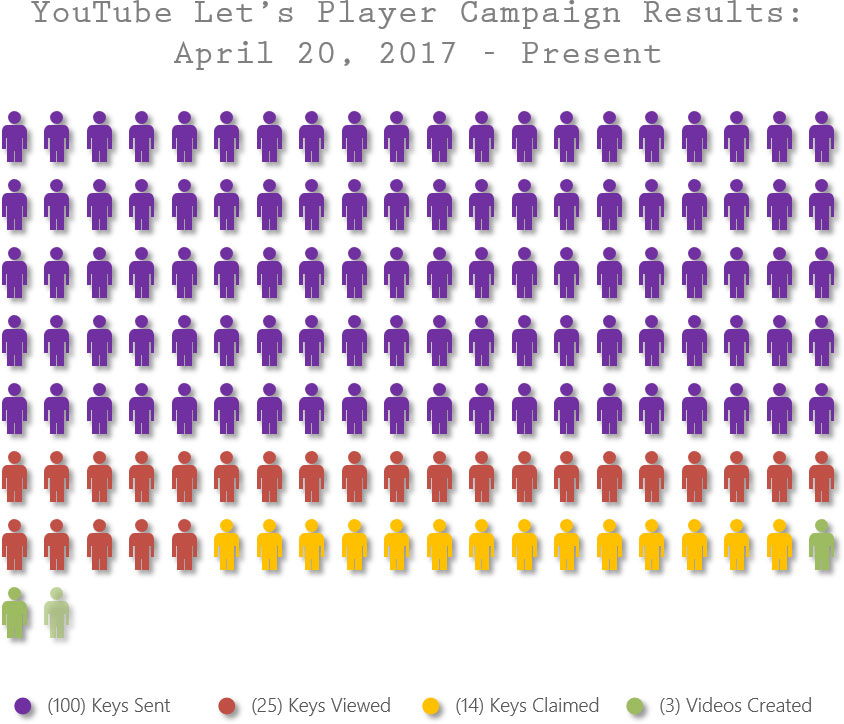
Of those original 100 or so emails sent out, 25 clicked the link to view their key, and of those, 14 claimed their key. Of those, only 3 went on to make Let’s Play videos.

So how do those figures stack up? Well according to Mail Chimp’s Email Marketing Benchmarks*, the Games industry average was a 19.71% open rate, and a 3.19% click through rate.

Since I emailed my recipients by hand, one message at a time, I can’t really say how many of the 100 odd that I emailed a key to actually opened the message, so instead I’m going to consider “key views” to be my open rate and “key claims” to be my click through rate.

Using those metrics, my open rate is 21% higher than the industry average, and my click through rate is nearly 4.5x greater than what I should reasonably expect.

I suppose that a 21% conversion rate (i.e. ~ 1 out of every 5 people who claimed a key made a video). That’s not terrible, but that was result of about 80 hours of work on my part…

I don’t have a full-time PR person, and have no way of distinguishing between people who are serious about exchanging services by helping each other grow versus dishonest scammers who just want something for nothing.

Going forward, if I do hand out keys, I will use a service like distribute() to do it.